The PANORAMIC Concept
Manipulating the stereo image in mastering is tricky; most stereo image processors use time-based delays between the left and right signal or discrete phase manipulation, creating significant changes in interaural differences but lacking mono compatibility and often altering the sound of a mix to the point where it no longer resembles the original mix.
Most mastering engineers avoid stereo-image processors because of this. They will fall back on several microprocessors to manipulate the mid-side signal, often phase-aware, customizable in their interactions, and respectful of the mix’s integrity.
These microprocessors and good DSP design, with mastering in mind, are at the heart of what Aperture is built around.
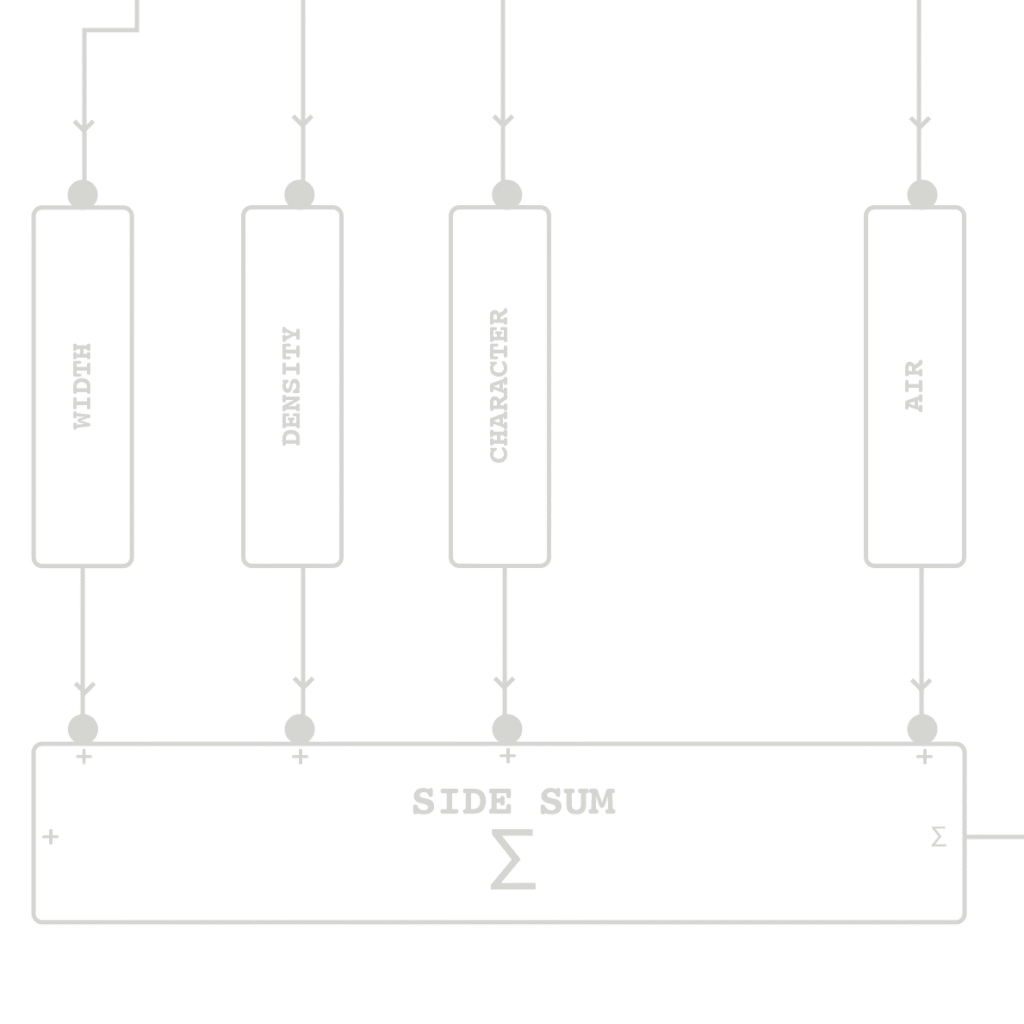
The concept for Panoramic originated in a sandbox design that mastering engineer Nicholas Di Lorenzo uses for mastering: four mastering processors in parallel on the side signal, blending into a summing bus.
Each of these processors has been designed and implemented with a mastering application in mind. This includes the phase coherency of the filters in each module, the harmonic structure each module can produce, and how the DSP aligns module paths using fixed alignment delays, FIR group delay, oversampling latency compensation, and smoothing before summing to ensure an accurate signal path.
These modules provide control over the overall width of the signal, density to bring out low-level information from the stereo field, saturation to add character, and excitement/sheen in the air module.