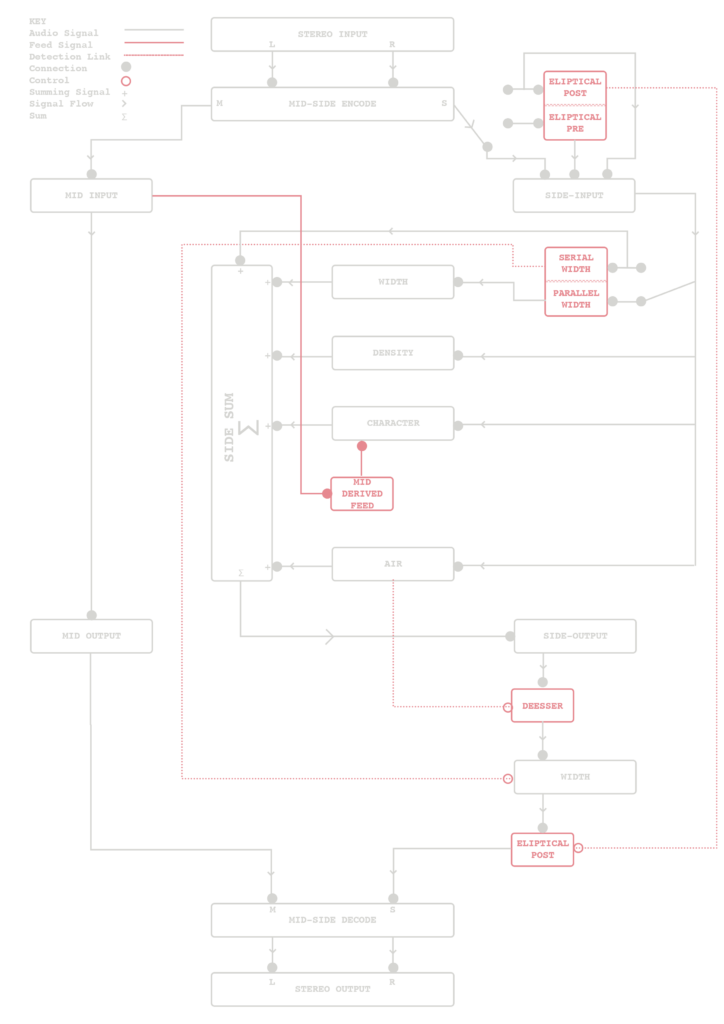
This is the roadmap of [PANORAMIC]. Read this to understand the why, what, and how of what happens under the hood!
So from the get-go, the signal is split into mid-side and enters a 3-way switch: [OFF], [ELIPTICAL PRE], [ELIPTICAL POST]
By default, the [ELIPTICAL] filter is [OFF], but if you want to, you can elect to mono-the low frequencies.
[PRE] – If the elliptical filter is in [PRE], low frequencies won’t affect dynamics processing or saturation in the plugin.
[POST] – If the elliptical filter is in [POST], the low frequencies will impact the way dynamics and saturation are created.
I like this option because if you want something with a bit more character in the stereo field, allowing those sub-frequencies and energy to leak into the processing helps generate harmonics/movement that, if you completely get rid of them, can sound a bit sterile.
The side input is split into 4 parallel signal paths that feed into a [SIDE] [SUM].
1. First [WIDTH] with a 2-way switch;
[PARALLEL] [WIDTH] runs the direct-thru parallel path to be able to increase and decrease the side-signal in parallel to the other 3 paths.
[PARALLEL] [SERIAL] moves that width module to after the summing of the parallel path, whereby it acts in a “series” after the processor.
2. Next, [DENSITY] is a parallel compressor. This is incredibly good at bringing out the sustain in the stereo image, think cymbal decay, the ring of toms on a drum or vocal choirs and stacks in a mix that need to hold focus in the stereo image
3. After that is [CHARACTER], an odd-harmonic saturation module. I chose odd harmonics to keep the waveform symmetrical, keeping the signal closely correlated with the original side-signal and avoiding left-right image shifting when decoded back to left-right.
Alongside character is a [STEAL] function, whereby harmonics are generated by the mid-signal and placed into the sides. These harmonics go through a mathematical process to decorrelate them from the original mid signal. Here’s why
If the harmonics correlate with the mid signal when decoding to [L] and [R], the stereo image will tilt toward [L] if in phase or toward [R] if out of phase.
4. The fourth module features [AIR], a linear-phase high-pass filter signal that is then saturated with odd-order harmonic distortion, giving the user the ability to add sparkly/sheen to the stereo image.
This is paired with a [DS] module that follows it and is a high-frequency compressor. [DS] addresses cymbals that are too harsh, guitars that are too edgy, anything in the sides that’s just “too much”. The [DS] function is not placed inside the module; it embeds itself after the [SIDE] [SUM] so it can process the entire side signal, not just in parallel.
These four modules go into [SIDE] [SUM], where they are summed into a new side-signal which represents the stereo information of the mix.