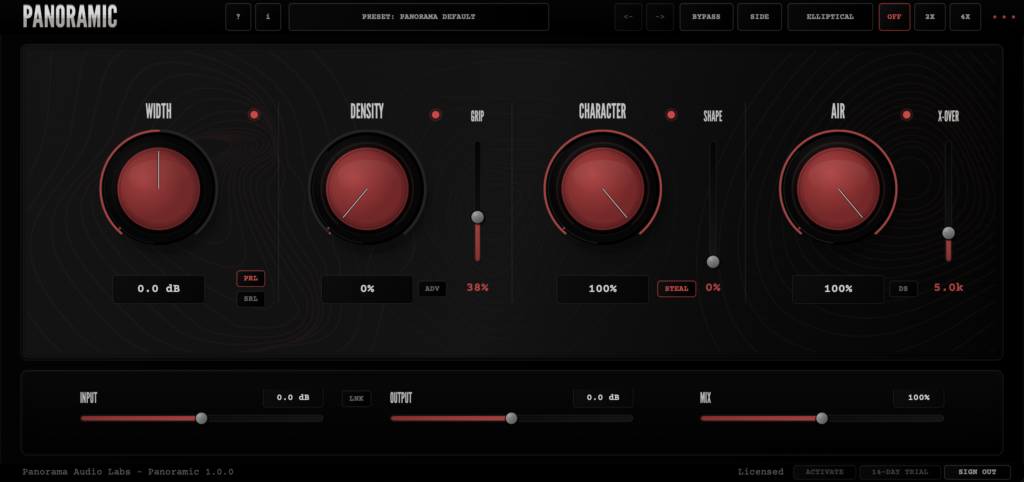
The original concept for Panoramic began three years ago, when I asked myself, “Can I build a stereo image mastering plugin better than what’s out there?” That question became the project’s core thesis.
The Stereo image and mastering
How we perceive, localize, and distinguish stereo information is directly determined by the interaural time differences. Many stereo image processors introduce time-domain delays between the left and right channels that exploit these psychoacoustic principles. This is not suitable for mastering applications, as independent time-domain changes between the left and right channels decorrelate the two channels’ phases, destroying the center image, its presence, and its tone. Phase decorrelation can be especially problematic for mono compatibility: when the left and right channels are summed to mono, phase differences can cause certain elements of the mix to become hollow, lose focus, or even disappear entirely due to phase cancellation. This is why maintaining phase correlation is critical in mastering.
A more acceptable way to manipulate uncorrelated information in a stereo signal is to encode the discrete left and right signals into two new paths: mid and side. The mid signal encodes the correlated phase between the left and right signals, and the side signal encodes the uncorrelated phase. This method enables independent processing of the center and side images.
Beyond mid-side features being a switch on some EQs or compressors, I saw an opportunity to use this encoding and decoding technique to build a mastering tool that didn’t otherwise exist.
At the time I developed this concept, I was very fond of Craig Brauer’s parallel-processing approach to mixing. Keeping the original signals intact and blending processing into parallel signals for core components of the mix, such as kick drums and snares, paired with Andrew Scheps’ approach to mixing vocals with 5 parallel effect channels, got me thinking.
On the 22nd of October 2022, I drew this graph, detailing the concept that four parallel side channels would sum into an MS decoder. Each parallel channel would allow the end user to manipulate different aspects of the side signal via gain, compression, saturation, and an exciter. The routing works as follows: the stereo input is first encoded into mid and side signals. The side signal is then split into four separate parallel processing channels, each dedicated to its respective effect. After processing, these four processed versions of the side signal are summed together and then recombined with the mid signal in the MS decoder to reconstruct the final stereo output. This structure allows precise and flexible treatment of the stereo field while maintaining phase correlation.
The saturation and exciter stages use DELTA signals, meaning that each effect creates only the difference between the processed and original side signals. In this context, a DELTA signal represents the isolated effect of the processing, so when the four parallel signals are summed, only the intended changes are added back in. This approach provides precise control and transparency, ensuring that effects are applied only during the summing of the four parallel paths.
- The parallel compression is set up per Bob Katz’s tonalization technique, with a fast attack (5ms), a slow release (80ms), and a high ratio of 4:1 to 8:1. Blended back in, this adds weight to the stereo field.
- The color/character module uses odd-order harmonic distortion (symmetrical). This matters because even-order harmonic distortion is asymmetrical. In a summing matrix, I considered it essential that the resulting waveform remain symmetrical to avoid errors when decoding from M-S back to L-R.
- Finally, the original exciter was built around a classic 4k linear-phase highshelf and saturation that could blend harmonics into the top end for extra sizzle.
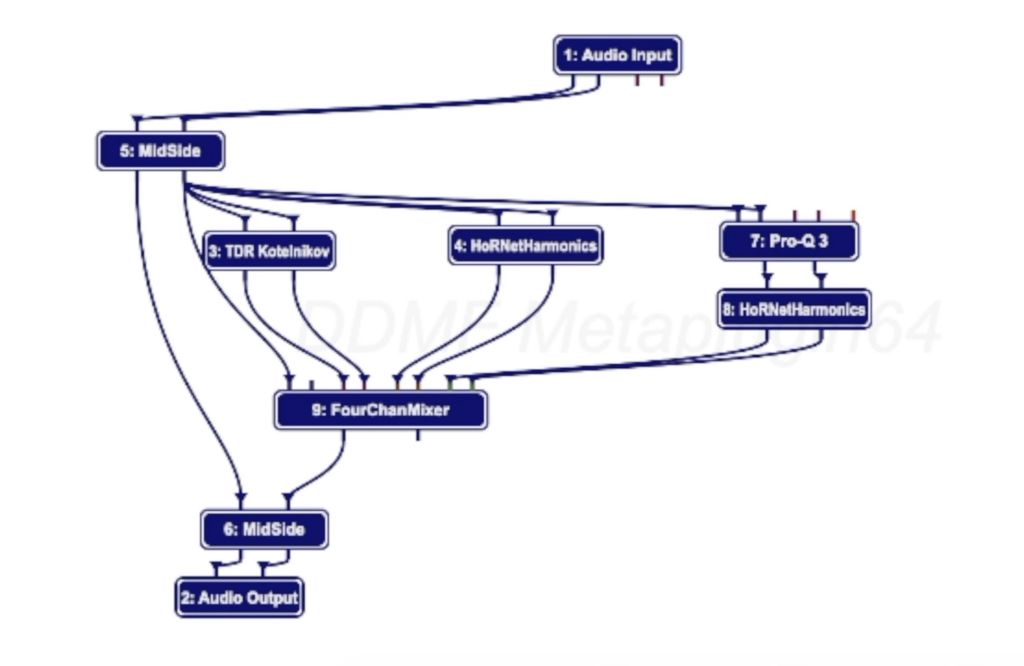
With this, I built my first concept inside a meta-plugin and controlled the processors with a 4-channel mixer. Each knob blends the gain, compression, saturation, and excitement.
This version of the concept was used on many of my mastering sessions and provided an invaluable ability to manipulate the side signal in mastering applications.
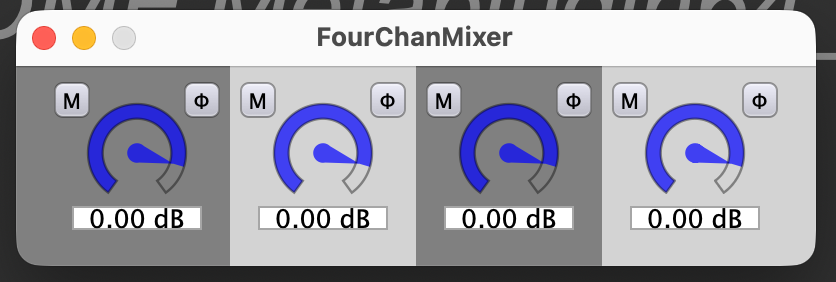
This concept is the basis I built the Panoramic plugin on.